How to assess the potential impact of AI on your portfolio

By Daniel Rourke, Head of ESG Integration at J.P. Morgan Private Bank, and David Wille, Vice President, J.P. Morgan Sustainable Investing Portfolio Management
Artificial intelligence (AI) has sparked immense excitement. Its most optimistic forecasters suggest it could help crack some of the toughest global problems. Although companies are just beginning to tap AI’s potential, here's a sign of what may lie ahead: AI has helped spark a new corporate research and development cycle that could spin out remarkable innovations, depending on how well it’s managed.
AI could widen the gap between market advancers and decliners, in Big Tech and across industries. As investors, we're actively assessing which are likely to be the most promising players. How are companies responding to the opportunities (in ways that may allow us to reap rewards)? How are they weighing the risks and mitigating them? The answers could translate to the bottom line – separating those companies and funds well-positioned to win in the market from those more likely to court controversies that affect returns.
Sorting through the mix, separating hype from real potential, sustainability is one of many lenses we’re using – to analyze AI’s possible impacts on the environment, the workforce and human rights and how those may affect bottom lines.
Here are some key areas we’re watching closely, examples where we think AI has the greatest potential and what to look for to help you make thoughtful, prudent investments.
What to watch: Where AI is fueling innovation
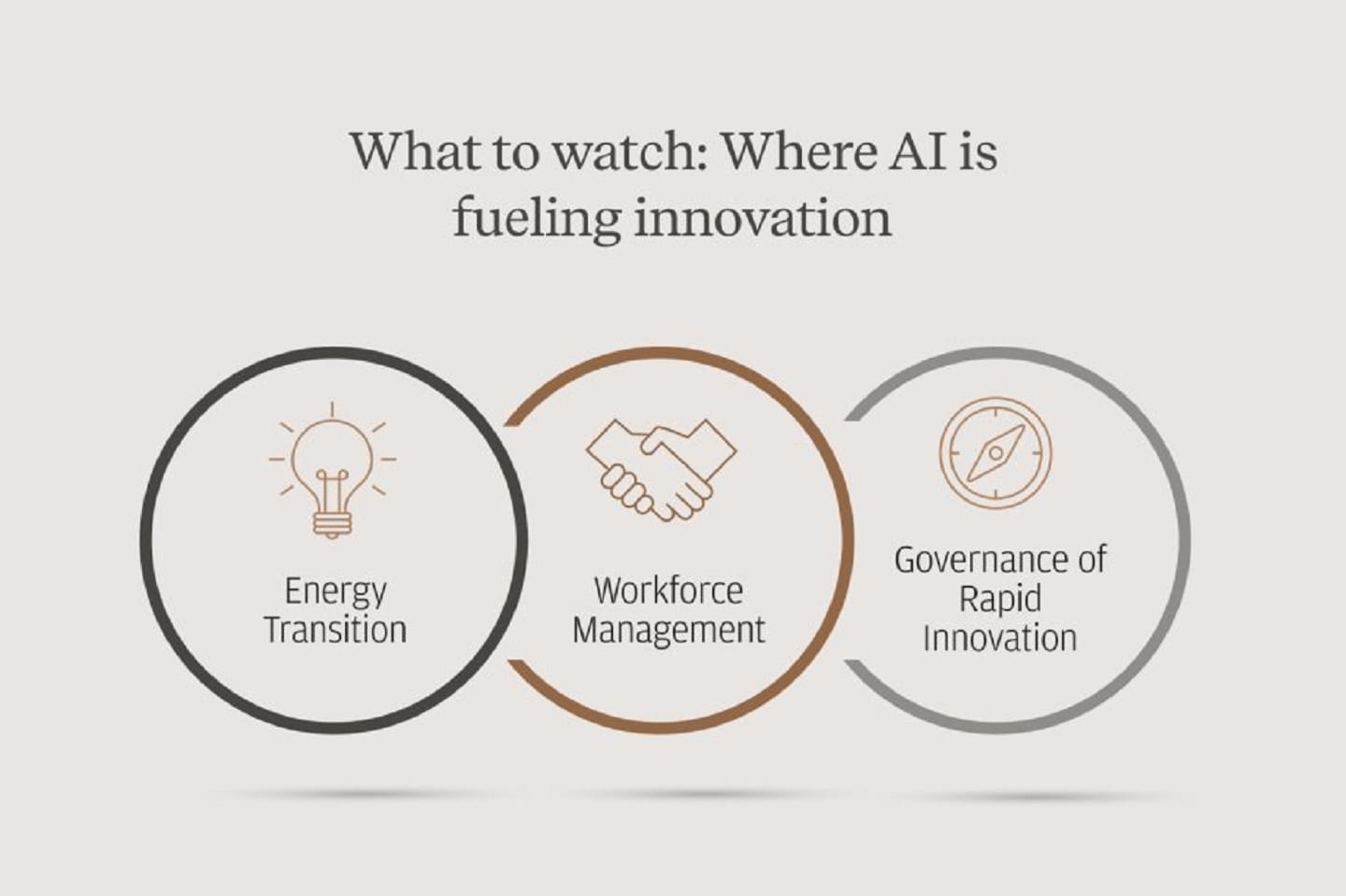
AI could be a catalyst for the energy transition, but it is also resource intensive
The International Energy Agency deemed AI and energy “the new power couple” because AI can enable more efficient, flexible and safe energy systems. It may also play a crucial role helping companies limit their use of scarce resources. (AI-enabled agricultural technology has already begun to conserve resources like water – and to boost yields, as well.)
Could AI be a catalyst for the energy transition if it’s also labor intensive?
AI-enabled innovations can help energy systems by producing data insights that spur action. “Smart” grids and meters that generate, digest and consume data can predict maintenance needs, forecast supply and demand and detect potential outages before they happen, lifting efficiency.
Get up to $1,000
When you open a J.P. Morgan Self-Directed Investing account, you get a trading experience that puts you in control and up to $1,000 in cash bonus.
Yet AI taxes resources. AI models are energy intensive – moreso as they grow in complexity. A query using generative AI (which produces novel, human-like output in text, image and video) consumes three to 30 times more energy than a Google search. And that usage might triple this decade.
Then there’s water: The supercomputers (and other infrastructure) powering AI need millions of gallons for cooling. That costs companies and challenges their sustainability efforts. Risk is growing in this area. Yet we see leading companies taking concrete steps toward improvement.
How could AI help the energy transition?
AI is proving a boon in renewable energy. For example, using AI to predict wind power output up to 15 days ahead can enhance its reliability, potentially increasing its market value and encouraging further adoption. But not every company is investing equally in these innovations. We like the actions of one leading U.S. utility company that is spending more than half its capital expenditure on renewable energy sources. It’s positioning for rising demand for clean energy and may benefit from AI’s ability to boost renewable energy assets’ value.
It's not just utilities. Some Big Tech companies are committing to fuel their power-hungry data centers with renewable energy. One AI-involved software company we like has secured far more renewable energy over a decade than its peers.
Our due diligence is also uncovering resource-conscious leaders among the semiconductor manufacturers whose microchips run AI applications. The industry’s latest generation of chips use 1/25th as much energy. Another leading chipmaker in a U.S. state with water scarcity is building a water recycling plant to supply more than half of its factory’s water.
Watch this when investing
We’re bullish on funds that invest in companies across sectors leaning into AI-enabled innovations that make their operations more energy efficient and that rely on wind, solar and other cleaner energy sources.
We can help you keep an eye on water and energy consumption issues – homing in on the investments with active commitments to meet AI power demands with efficient, cleaner energy sources, and with track records of following through on this.
If AI hits workers, will companies be ready?
How might AI change the labor market? Shifts may include surging demand for highly skilled talent, which must be attracted, retained and developed. And if the technology lifts productivity dramatically, companies may need to invest in retraining and upskilling their workforces. No one knows exactly how it will play out, but here’s our thinking right now.
Has AI reduced the number of jobs?
So far, there is little evidence AI has reduced the number of jobs, but the risk remains substantial: The Organisation for Economic Co-operation and Development (OECD) estimates that 27% of jobs are at the highest risk of being replaced by automation. Setting aside the many non-investment issues this raises, companies will surely be challenged. Then there’s the matter of integrating AI at work – which may well demand more IT and tech talent than companies now employ. Finding them could be tough: Only 13% of employers polled in a 2021 survey said they could “hire and keep the tech talent they need most.”
How might AI help the workforce?
We like companies and funds that understand good workforce management. That might mean they’re retraining, or more broadly creating cultures of continuous learning and development. In one particular example, a number of companies are joining together to create an AI Workforce Consortium focused on “upskilling and reskilling roles most likely to be impacted by AI … enabling workers to find and access relevant training programs and connecting business to skilled and job-ready workers.” This group has established goals aligned to skill development and training programs to educate 95 million workers over the next 10 years. Actions like this make sense – they’re designed to fortify the local talent pipeline.
Watch this when investing
How companies are handling changes within their workforces is a long-term endeavor. We favor investors with deep understanding of human capital and labor dynamics, practiced at assessing which companies are balancing recruiting, retaining and retooling. Those that do should be well positioned, if and when AI shifts their business models.
Are companies governing AI responsibly?
The quality of corporate governance can be a powerful determinant of investor returns. AI could have significant implications – in two ways: It may strengthen the governance process, and yet AI itself needs strong governance.
How could AI help companies innovate?
Innovations driven by AI could make corporate governance more transparent and executive decision-making more accountable. AI introduces potential risks – to privacy, to security, or spreading dangerous misinformation and bias. Yet well-governed AI can offer the chance to better engage customers, employees, shareholders, suppliers, local communities, regulators – all stakeholders – and to strengthen compliance and risk management. Keeping a human presence in the loop is something we find important to balanced success.
What are examples of companies that are innovating with AI?
We like the practice of one leading company involved in AI: Early on, it published AI development principles to guide its rollout of innovations to its products and services. Another leading company in AI development established an AI-focused ethics office to monitor and ensure its products were being used responsibly. These corporate actions signaled to investors a commitment to operate with appropriate checks and balances, and to maintain trust with its customers, employees and other stakeholders.
These good governance practices mitigate the risk of litigation and help establish (or reinforce) that the companies are brands you can trust. And trust can pay dividends for investors.
Watch this when investing
It is still early days. We’re watching a number of AI risks, from undermining privacy and data security to contributing to misinformation and bias. Intentionally or not, consumers armed with AI can quickly disseminate disinformation. In this context, shareholders are asking companies to discuss their guardrails. The focus is on disclosure, and measuring AI systems’ transparency and fairness.
Invest your way
Not working with us yet? Find a J.P. Morgan Advisor or explore ways to invest online.