How actively tax-managed investment portfolios can help you keep more after taxes
- Taxes can slow growth in taxable investment accounts because you may owe tax on interest, dividends, fund distributions and realized gains, reducing what stays invested and compounds.
- A tax-aware approach to investing can include tax-loss harvesting, which involves realizing losses to help offset gains and support reinvestment decisions over time.
- A continuous approach can use market volatility opportunities to help offset gains triggered by rebalancing, withdrawals or portfolio changes, helping you keep more of what your portfolio earns.

Most investors spend a lot of energy focused on returns, and rightfully so. They seek to invest in market sectors that are poised to outperform, identify securities that may be undervalued and select portfolio managers with a proven track record.
These aspects of investing are certainly important, but they miss a crucial piece of the picture: what you actually earn after taxes. Indeed, pre-tax performance is only part of the story; after-tax returns are what build wealth.
Though sometimes overlooked, taxes can work against your portfolio returns. Unlike a one-time market drop, taxes can create an ongoing drag in taxable accounts – year after year – depending on your holdings, turnover and tax rate. But active tax management of an investment portfolio may help reduce that ongoing drag created by taxable gains.
Taxes can hurt your portfolio’s ability to compound
Compounding is at the heart of long-term wealth building. It is the concept that returns can build on returns, year after year. But compounding works only when the dollars remain invested in the portfolio over time.
Every time an investment portfolio realizes capital gains, investors owe taxes on those gains. Unless paid with cash (which could be spent on other things), paying the tax bill from the portfolio reduces the amount left invested, which in turn could reduce the base on which future returns compound.
Let’s consider how this might play out in a hypothetical scenario. A $500,000 portfolio invested in global equities could face an annual tax drag of roughly 1% to 2%, driven largely by capital gains distributions. This might not sound like a big deal, but the compounding effect over 10 years can reduce the portfolio by somewhere between $160,000 and $306,000 compared to a portfolio with active tax management, as seen in the chart below. That’s a meaningful portion that some investors might not even notice.
The impact of taxes on a stock-only portfolio
Assuming $500,000 initial investment in global equities
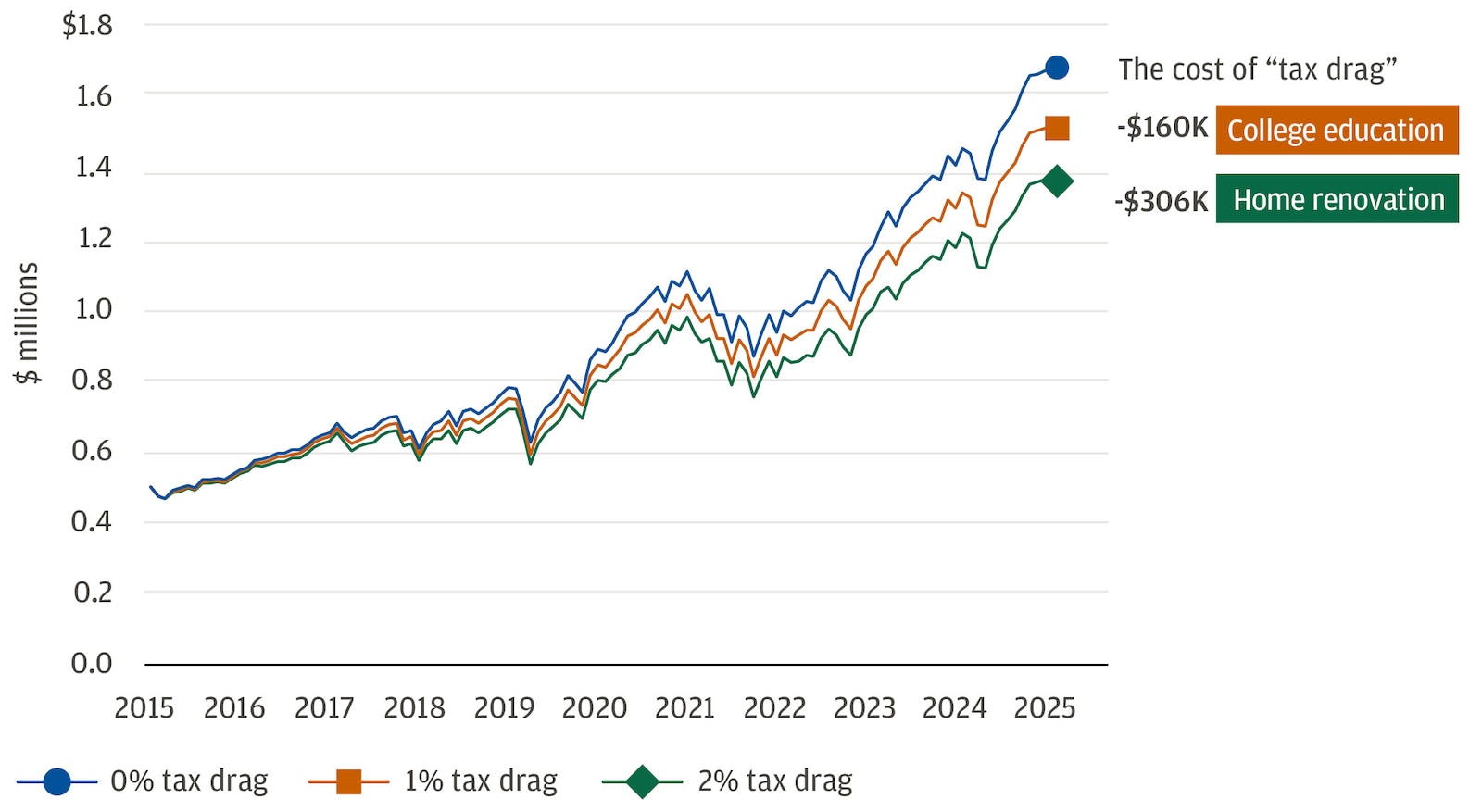
This is why the way a portfolio is managed can matter just as much as what it holds. Proactive tax management can help to address this friction before it compounds against you. If realized gains are inevitable over time, the advantage can come from capturing losses along the way to help offset them.
Interested in working with an advisor?
Work 1:1 with our advisors to help build a personalized financial strategy that’s built around you.
How continuous, proactive tax management can help keep more money in your pocket
Active tax management is a continuous approach to investing that keeps taxes in mind, with the goal of supporting after-tax outcomes. It can include realizing losses to help offset gains, rebalancing in tax-aware ways to manage potential tax impact and selecting which shares to sell with tax considerations in mind.
The goal is simple: Keep more of your money invested so it has more time to grow. You can do this on your own or work with a professional.
Tax-loss harvesting is one of the most widely used tools within this broader approach. At its core, the strategy involves realizing capital losses within a portfolio to help offset gains. By doing so, investors may reduce current tax liability and preserve more capital for reinvestment, which can improve after-tax compounding over time and maximize long-term wealth. It doesn’t guarantee higher returns but is designed to help reduce tax friction, which can support better long-term outcomes.
In practice, harvesting losses manually can be challenging. Many retail investors look only for harvesting opportunities at year-end, which can miss losses that appear and fade throughout the year. By contrast, professionally managed portfolios that use advanced technology tools can more easily support a systematic, ongoing approach, so loss-harvesting decisions are integrated with broader portfolio management.
That regular cadence matters because opportunities don’t depend on a particular market environment. There‘s a common misconception that tax-loss harvesting is most valuable – or even only possible – during bear markets, when losses are plentiful. Major downturns can create larger losses, but consistency matters. Markets move every day, and individual stocks within a portfolio diverge, meaning a portfolio can have both gains to manage and losses to capture even when the overall market is up.
Active tax management in global markets
Opportunities for ongoing, systematic tax-loss harvesting exist in both up and down markets
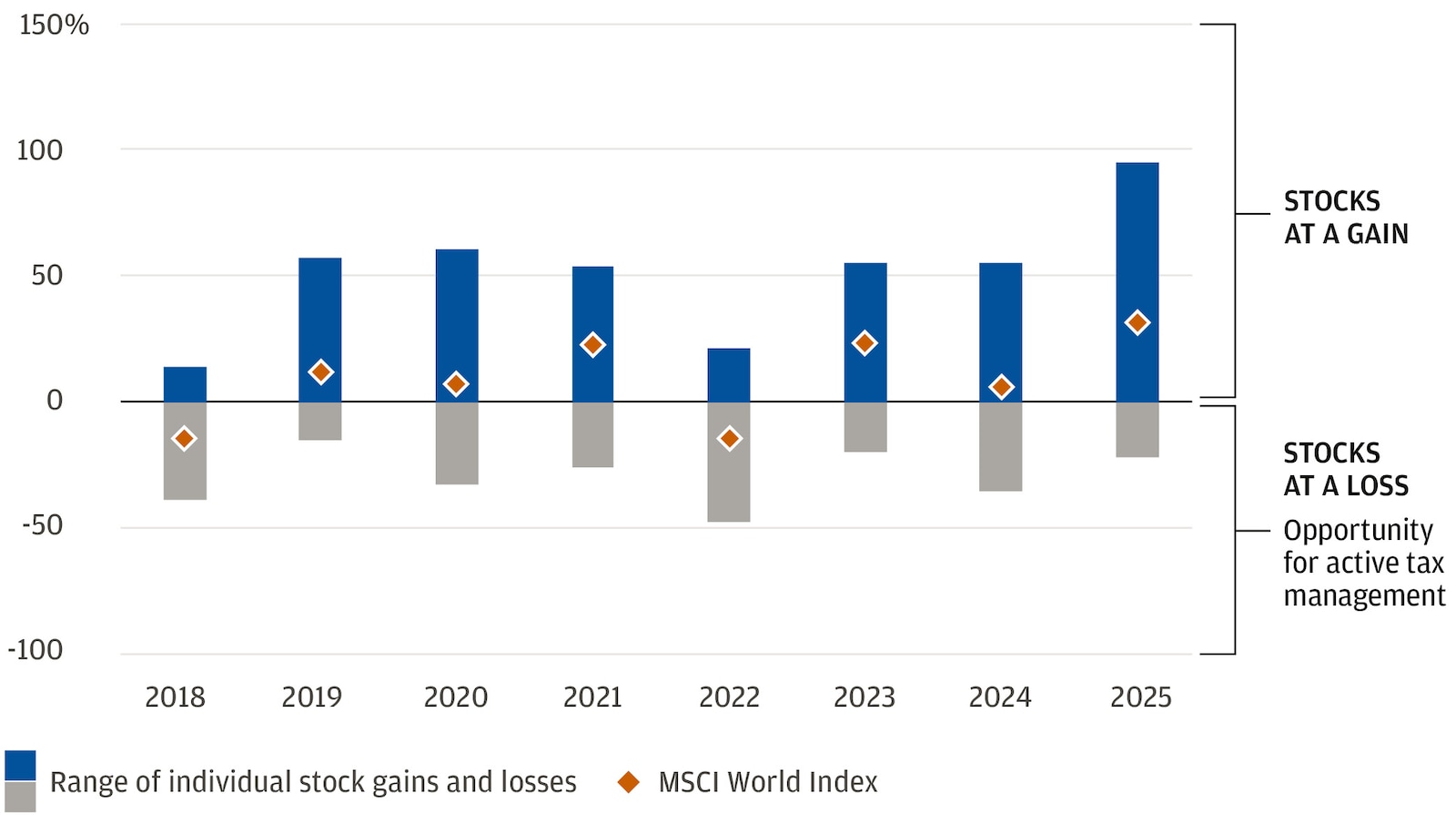
Past performance does not guarantee future results. It is not possible to invest in an index.
The bottom line
Pre-tax returns matter, but compounding after-tax returns are what ultimately build wealth. Taxes can quietly chip away at compounding, reducing the dollars left to stay invested. Active tax management is designed to address that friction throughout the year using a year-round, tax-aware approach that may help identify opportunities that can be difficult to track with periodic or manual monitoring alone. Tax-loss harvesting can be a key part of this approach for certain investors. The goal is not to chase higher returns – it’s to stay mindful of taxes so more of what you earn can remain invested over time. Talk to your J.P. Morgan advisor and tax professional to evaluate whether a tax-aware approach fits with your investment plan.
Invest your way
Not working with us yet? Find a J.P. Morgan Advisor or explore ways to invest online.