April 2025 JOLTS report: US labor market stays resilient

Global Investment Strategist

What’s become clear over the past month is that U.S. businesses are indeed paying the added costs of tariffs and we are watching to see if pressure on profit margins will result in meaningful layoffs.
On Tuesday, the Bureau of Labor Statistics released its monthly Job Openings and Labor Turnover Survey (JOLTS), which showed a labor market that remained resilient in April. Here are four key components of the survey:
Work with an advisor
Our advisors can provide ongoing financial advice on how your portfolio can adapt to the changes in the market, your life and your goals.
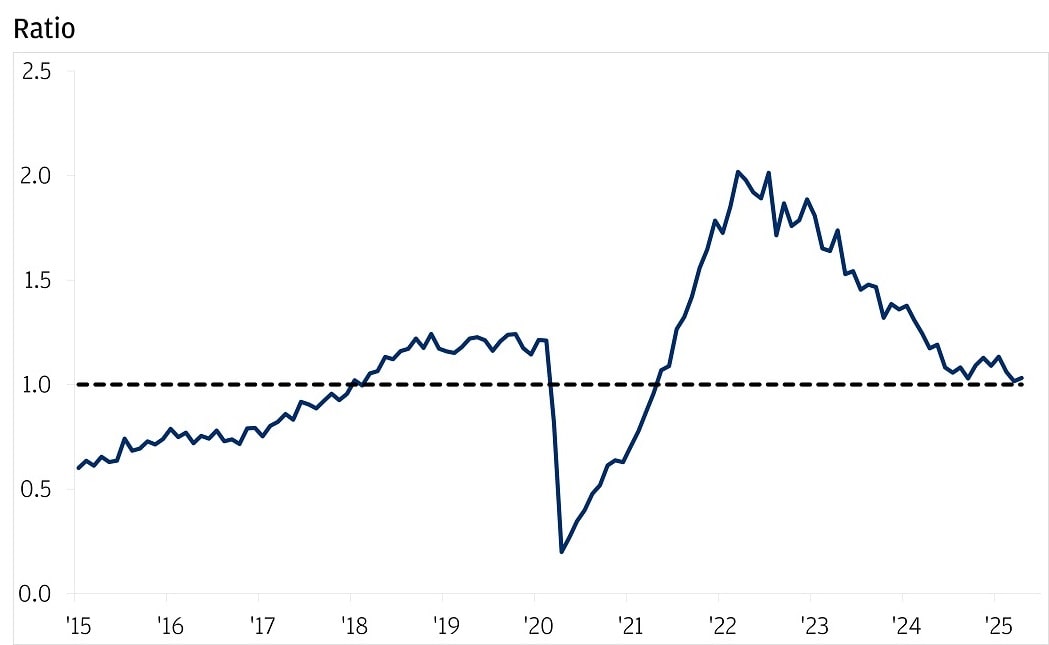
- Job openings: This metric reflects labor demand. When the economy is strong, the level of open positions is high. As an example, as the labor market tightened (was getting stronger) in 2021 and 2022, openings peaked at close to 12 million positions. Today, that number is close to 7.4 million and as the chart below shows, there is roughly one job opening per one unemployed person. The chart illustrates that while the labor market has cooled since 2022, it remains near the levels seen pre-pandemic, implying a healthy labor market in terms of supply and demand.
- Layoffs rate: As the name would suggest, the layoffs rate measures the number of layoffs during the month as a percentage of total employment. During the pandemic, the layoffs rate shot up to close 9%. While the layoff rate did increase marginally in the latest data release (from 1% in March to 1.1% in April), it remains below the 1.3% rate seen prior to 2020. Interestingly, the layoffs rate in the Federal government fell to 0.1% in April 2025, down from 0.6% in February and 0.3% in March.
- Hires rate: The hires rate helps to add context to labor market turnover. When the economy is strong, we would expect the hires rate to increase as businesses look to fill open positions quickly to meet consumer demand. The latest data shows that the hires rate ticked up from 3.4% to 3.5% but remains well-below the post-COVID peak of 6% and below the pre-pandemic hires rate of 3.8%, which signals relatively tepid hiring during the month.
- Quits rate: Like the hires rate, we would expect the quits rate to also increase as the labor market strengthens. With increased demand for labor, more people will voluntarily quit their job to take a new one, often at higher wages. The recent quits rate fell from 2.1% to 2%, which is also below the post-pandemic high of 3.2% and below the pre-pandemic level of 2.3%. Higher uncertainty is likely weighing on the willingness of employees to leave their existing jobs for new ones.
All in all, the data we received in the JOLTS report does not change the narrative of a labor market that remains healthy but ‘in limbo’ as businesses and consumers alike try to sort through recent trade discussions. Our outlook continues to be that that the labor market is likely to weaken modestly in the coming quarters as the full force of higher tariffs comes into effect. Friday’s employment report will be the next litmus test for how the labor market is handling the elevated levels of trade and fiscal policy uncertainty.
Job openings per unemployed worker
All market and economic data as of 06/4/25 are sourced from Bloomberg Finance L.P. and FactSet unless otherwise stated.
Explore ways to invest
Take control of your finances with $0 commission online trades, intuitive investing tools and a range of advisor services.