How young athletes can navigate NIL money to help set themselves up for financial success

Executive Director, Wealth Advisor
J.P. Morgan Athlete Center of Excellence
- Prepare to achieve your financial goals: Earning money as a college or professional athlete presents unique challenges and opportunities. The choices you make today and the support you seek can help you achieve your financial goals, now and in the long term.
- Assemble your all-star team: Having the right team – such as an agent, accountant, financial advisor and attorney – can help athletes navigate challenges and help maximize their career and financial potential.
- Invest early to help grow your wealth: Investing early can tap into the power of compounding and possibly allow you to increase your potential long-term wealth.
- Build a strong personal brand: Cultivating a personal brand is an important tool for athletes to diversify their non-sport earning opportunities through potential endorsements and partnerships.

The 2021 rule change allowing NCAA athletes to profit from their name, image and likeness – or NIL – ushered in career- and wealth-building opportunities that were previously inaccessible to college athletes.
But it also brought the challenges of signing an NIL deal and running a business, including managing taxes, building a personal brand and assembling a good support team.
By prioritizing financial planning and education, student athletes – including college players and those who are going pro – can set themselves up for success in their sports careers and beyond.
What are the money and tax implications of NIL
NIL policies allow student athletes to earn money from things like product endorsements, business partnerships and merchandise licensing. Under such deals, athletes are generally considered independent contractors, rather than employees.
This distinction means that taxes are not automatically withheld from any income that athletes earn from NIL deals. By contrast, any paycheck that an employee receives will already have taxes deducted from that individual’s gross earnings.
These two types of income come with two different IRS classifications: 1099 for independent contractors and W-2 for employees.
As 1099 workers, student athletes participating in NIL deals are responsible for tracking their taxable income, which can include earnings from cash and cash equivalents like stocks or other investment assets. It can also include goods and services that are provided as compensation for NIL work, like a pair of sneakers received in exchange for a brand endorsement. To avoid penalties and interest, college athletes may need to make estimated tax payments each quarter.
College athletes who transition into professional sports careers can find themselves earning both types of income, depending on whether they play on a team or in an individual sport like tennis or golf. Those who sign with professional sports teams typically earn regular salaries and often receive additional incentives, like signing bonuses. These earnings are classified as W-2 income.
In addition, pro athletes can earn 1099 income, similar to college NIL earnings, from endorsements, royalties and potentially prize money, depending on the sport.
Further, you may owe state tax to a state where you earn income from NIL activities. Keep track of the locations where you perform NIL contract services and consider consulting a CPA or other tax professional to understand state tax requirements and to help you meet state filing requirements.
Importance of financial education for NIL athletes
Making your first windfall from a lucrative NIL deal or a professional signing bonus is an exciting career milestone – but possibly an overwhelming one. Whether you’re at the start of your college athletics career or preparing to go pro, it will help to understand basic financial concepts. This includes learning how to create a budget and build credit while also saving and investing for the future. Starting with a basic financial education will help you make informed money decisions as your career progresses.
Create a budget
One of the first steps in developing a financial plan is creating a budget. This requires calculating your income and expenses, as well as setting goals for savings and investments. Earnings from NIL deals and professional sponsorship offers can fluctuate month-to-month, so it may be necessary to estimate an average monthly income. A more conservative estimate here can help you avoid overspending.
Understanding how to balance your income against your expenses – in other words, managing your cash flow – can help ensure you always have enough cash on hand to pay bills, including tax payments, while still working toward your financial goals.
To budget your expenses, a good starting point could be the “50/30/20” rule, under which 50% of your income goes to needs, 30% goes to wants and 20% goes to savings. Ultimately, however, your budget should be designed to meet your specific needs and goals. As athletes typically reach peak earnings earlier in their careers relative to other professionals, an appropriate budget could entail larger savings contributions during prime earning years.
Build credit
Establishing a good credit history can make you better prepared for life’s biggest financial decisions, as well as may grant access to lower interest rates, higher credit limits and other favorable financial terms.
One of the most common ways to start building credit is to use a credit card. Student athletes with no existing credit history may be eligible for a secured card or beginner credit card. Another option is to become an authorized user on a family member or friend’s credit card account. Keep in mind that actions of the primary credit card account holder – positive or negative – may impact your credit as an authorized user on the account.
A good credit score can then be established by making on-time and in full payments on any credit card purchases. Setting up an autopay can help ensure you don’t miss any deadlines.
Saving and investing
Saving and investing is how you prepare for your financial future, from near-term goals like buying a car to the long-term needs of retirement.
One of the first steps is setting aside cash for an emergency fund – a good rule of thumb is three to six months of living expenses. Once that is established, you can start saving money toward other goals. Investing your savings in vehicles like an interest-earning savings account or a low-cost index fund can help that money grow over time, helping you reach your savings goals.
Personal branding for NIL athletes
For college athletes pursuing NIL deals and pros navigating licensing and endorsements, building a personal brand is essential. Your personal brand can serve as both your marketable identity and a public expression of your values. Building a strong brand will give you better access to business opportunities that reflect those values and help you achieve your career and financial goals.
As you start to explore endorsement and partnership opportunities, consider how those opportunities may reflect on your personal brand. While it may be tempting to accept any lucrative offer that comes your way, being thoughtful about the NIL deals you pursue will serve you better in the long run.
Building your professional support team as an athlete
If all of this is starting to sound like a lot to manage, don’t worry: You don’t have to do it alone.
Many professional athletes have a team of people behind them to help manage their financial, brand and career decisions.
- Agent: An agent can help you manage your career, including negotiating pay, choosing the right business partnerships and managing your personal brand.
- Accountant: An accountant can help you stay on top of your tax payments for 1099 income, as well as navigate any other complexities that can come with earning money as an athlete.
- Advisor: A financial advisor works to help you reach your financial goals, including developing an investment strategy that’s in line with your objectives and risk tolerance, as well as helping you plan for retirement and beyond.
- Attorney: An attorney’s job is to protect your interests by working alongside agents to negotiate contracts, safeguarding intellectual property and NIL rights and handling any legal disputes.
Choosing your team members carefully is important to ensure you get the support you need. Take the time to thoroughly research and weigh your options, and consider asking teammates or other fellow athletes for recommendations. Be sure to verify the credentials of any professionals who you are considering working with. For example, you can use the Financial Industry Regulatory Authority (FINRA) BrokerCheck website to look up a prospective financial advisor.
How athletes can invest now to build long term wealth
When developing a financial plan, focus on paying yourself first. That means allocating a defined portion of your income for savings and investments, while leaving enough money to pay other bills or expenses. This makes savings non-negotiable.
It will also help you get a head start on building wealth, as the sooner you start investing, the more you can potentially earn in the long run. This is because investment returns compound over time – in other words, you earn returns on your returns.
Compounding can be even more powerful for long-term investing goals like retirement when you consider the 10-year historical average return for the U.S. stock market is approximately 10%. Assuming a $10,000 initial investment in a S&P 500 index fund, for example, this would equate to approximately $174,500 in returns after 30 years.,
Investment growth over time
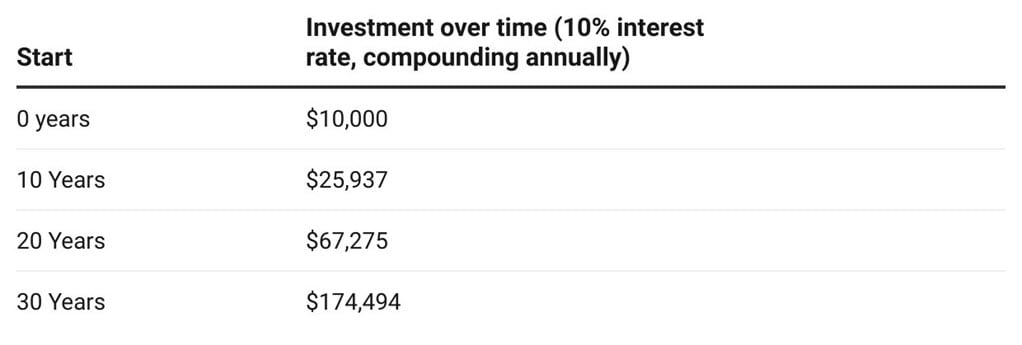
Even if you’re just getting started in your athletics career, you can start small with your initial investments and build out a diversified portfolio over time, according to your investment goals.
Prepare for potential relocation
Athletes who are planning to join a professional sports team may want to be prepared to relocate for their career – potentially multiple times, if they are traded or choose to sign with another team after their contract expires.
When moving to a new city or state for work, a relocation checklist can help you stay organized. Here are some example checklist items:
- Research neighborhoods and set your living budget: Research the new location, including learning about different neighborhoods and determining an appropriate budget for buying or renting a home.
- Ask if your team provides moving assistance: Find out what moving assistance your new team provides. For example, Article III of the NBA’s current collective bargaining agreement states that when a player is traded to a new team, that team will reimburse “reasonable” moving expenses, hotel costs for up to 46 days and three months of housing costs up to $6,000 per month.
- Select your next home: Choose a new home that aligns with your wants and needs. Consider factors like whether it makes more sense to rent or buy, whether you will live alone or with others, and how close you would like to live to places like restaurants, parks, shopping or your team’s facilities.
- Prepare to move out of your current home: If applicable, terminate your lease or put your current house on the market. Other loose ends to keep in mind include bills like utilities and Wi-Fi, which will need to be canceled or transferred to the new owners.
- Complete remaining administrative tasks: Make a plan to handle any remaining administrative tasks, like changing your address on all of your bank and investment accounts and ensuring your mail is forwarded to your new home.
These examples are by no means an exhaustive list. If you are relocating as an athlete, consider consulting with an agent or financial advisor to help you understand what resources are needed as you prepare for your move.
Pitfalls to avoid as a new NIL or professional athlete
- Falling for too good to be true opportunities: The sudden onset of money and fame that can go hand-in-hand with success as a young athlete brings risks as well as rewards. Be wary of opportunities that sound too good to be true – because they may very well be.
- Making unplanned big purchases and not following a budget: It’s important to think carefully about any big purchases to avoid impulse spending. In addition, try to stick to a budget that sets aside money for savings and bills before making any discretionary purchases. That way, you have an emergency fund to fall back on in case anything goes wrong.
- Sharing your wealth without a plan: You may want to share some of your newfound wealth with the family and friends who have supported you in your athletic ambitions. Because money can be a sensitive topic, you should approach any gifts with careful consideration. It may help to have a conversation with these family members and friends to set expectations in order to avoid resentment on either side.
The bottom line
Thoughtful planning and a solid financial education can help young athletes navigate the challenges of NIL and going pro, from managing different types of income to building savings and investments for the future.
It also helps to have the right team around you. For financial guidance throughout your athletic career, consider partnering with a J.P. Morgan advisor.
Invest your way
Not working with us yet? Find a J.P. Morgan Advisor or explore ways to invest online.