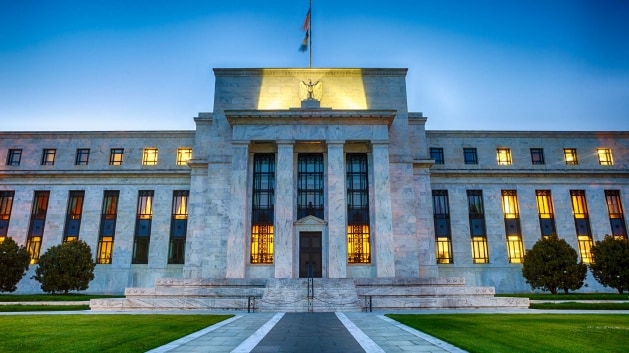
Are Fed officials changing their tone ahead of October’s FOMC meeting? Here’s what they’re saying

Editorial Staff, J.P. Morgan Wealth Management
- Federal Reserve (Fed) officials are sounding more hawkish heading into the October FOMC meeting – meaning they’re more focused on fighting inflation and are signaling rates might need to rise further if price pressures don’t cool.
- Policymakers seem to be keeping the door open to further tightening while stressing that the next move will depend on incoming economic data.
- Markets are starting to expect interest rates will stay high for longer, and that any future rate cuts may come later than people once thought.

In the weeks since the Fed’s September rate hike, a steady stream of public remarks from policymakers has taken on a noticeably more hawkish tone as attention turns to the next Federal Open Market Committee (FOMC) meeting on October 27–28. Officials have been more direct about inflation risks, more cautious about declaring progress and more willing to keep rate hikes in the conversation.
For investors, this matters because Fed speeches may influence markets before the next meeting does. When policymakers sound more concerned about inflation – or more determined to keep policy restrictive – markets can quickly reprice expectations for the path of interest rates, which can ripple through bond yields, the U.S. dollar and other rate-sensitive parts of the market.
“It is striking how quickly the debate about Fed hikes has changed: Not too long ago markets and the Fed debated whether hikes were needed at all,” J.P. Morgan Private Bank’s Head of Rates and FX Strategy Ebrahim Rahbari said. “Now markets and the Fed are discussing the possibility of a conventional rate hiking cycle.”
Looking at recent comments from key Fed officials, a few big themes have emerged.
A hawkish tone: Why Fed officials seem keen on keeping rates higher for longer
Following the September rate hike – the central bank’s first in over three years – Fed officials have increasingly returned to a familiar message: The inflation fight may not be finished, and additional rate hikes could still be on the table if price stability isn’t achieved. The overall message has become more about guarding against inflation proving stubborn or reaccelerating before it’s fully under control.
A more hawkish tone does not signal that the Fed is locked into a predetermined decision at the October meeting. It can mean another rate hike is still possible – whether in October or later, while also signaling a higher bar for future rate cuts and the potential for rates to stay high for longer. In that context, policymakers can sound tough on inflation while still stressing that decisions will depend on incoming economic data.
Persistent inflation remains the top concern for officials. The conflict with Iran has raised the risk of an energy-related supply shock: Higher oil and diesel prices can keep headline inflation elevated, and if those pressures persist, they can gradually feed into broader costs for businesses and consumers. At the same time, Fed officials know markets can move quickly if investors start assuming rate cuts are around the corner – so firmer language can be a way to keep expectations steady while they wait for the next round of economic data.
The timing is notable. The latest Personal Consumption Expenditures (PCE) Price Index report – one of the Fed’s preferred inflation gauges – came in softer than expected in August, which could point to cooler inflation. But many officials have signaled they’re not ready to declare victory based on one report, and that next steps will still depend on incoming data.
What key Fed officials are saying ahead of the October meeting
Kevin Warsh (Fed Chair)
Warsh has been using firmer language to describe the Fed’s stance following the September decision, saying in his press conference that the latest rate increase “removed a dose of accommodation.” In other words, the Fed is making policy less supportive and more restrictive to help bring inflation down. He kept the focus on restoring price stability, while once again declining to provide forward guidance – a stark contrast with other Fed officials who continue to share outlook-related views publicly.
Neel Kashkari (Minneapolis Fed President)
“Inflation is still too high,” Kashkari told CNBC in an interview on September 30. “It’s been elevated now for more than five years. I didn’t think the [PCE] inflation data today really changed that story for me very much.” He added that the economy remains “resilient” for now, while the labor market looks “pretty good” but not “great.”
Lisa Cook (Fed Governor)
Cook said publicly on September 28 that she expects inflationary pressures to continue, mainly from the artificial intelligence (AI) buildout as well as higher oil prices and supply chain disruptions associated with the conflict in the Middle East. While she stopped short of saying more interest rate hikes will be needed, she did say that future decisions will depend on economic data. “The labor market appears to be well positioned to handle an increase in rates,” she said.
John Williams (New York Fed President)
Williams said in public comments on September 24 that investor sentiment suggests it is “reasonable” and "likely that another rate hike may be appropriate by the end of the year.” He followed that up with additional comments on September 29, in which he hinted that the central bank doesn’t need to rush to raise rates. “With the policy action we took at our September meeting, there is no need for urgency,” he said, adding, “we have time to wait.”
Beth Hammack (Cleveland Fed President)
Hammack underscored that prices remain “elevated” and the central bank has its work cut out for it. “The inflation outlook continues to be highly uncertain, with risks tilted to the upside,” she said in remarks on September 24. “The longer that high inflation persists, the more challenging and costly it can be to bring it back down.”
Michael Barr (Fed Governor)
Barr said in a speech on September 23 that more rate hikes were likely needed to bring down inflation. “Inflation is above our 2% target and not clearly trending toward target in a timely way,” he said. “Further policy adjustments are likely to be needed to ensure inflation comes down to target in a timely fashion.”
Susan Collins (Boston Fed President)
Collins warned on September 23 that there was an “increased likelihood” that inflation will stay “notably” above the Fed’s long-term target of 2%. “The upside risks to inflation have increased,” she said, adding, “a somewhat more restrictive federal funds rate will help ensure that inflation durably returns to target.”
Thomas Barkin (Richmond Fed President)
In remarks on September 22, Barkin said inflation risks currently outweigh employment risks and suggested that one rate hike may not be enough to tame inflation. He called inflation, which has been above the Fed’s 2% target for more than five years, a “troublemaker” and warned cost pressures could drag on if not dealt with.
Anna Paulson (Philadelphia Fed President)
On September 22, Paulson described inflation as stubbornly elevated and kept additional moves on the table. The recent rate hike “brings policy closer to what I believe is needed,” she said in prepared remarks, while adding that “some modest further tightening may be warranted” to tame inflation.
Austan Goolsbee (Chicago Fed President)
The Fed is facing persistent supply shocks that have driven up inflation, and rate hikes are necessary but will likely be “painful,” Goolsbee noted in remarks on September 21. “The only way to bring inflation down is to raise rates and narrow the gap between supply and demand,” he said. “Forcing inflation back to target in the short run means pushing employment below target.”
Jeff Schmid (Kansas City Fed President)
On September 18, Schmid said in a speech that the Fed still has “work to do on inflation,” reinforcing the idea that higher prices are not yet fully contained. “Higher oil prices have been an important driver of elevated inflation, but it is important to acknowledge that our inflation problem is not just about energy,” he said.
Interested in working with an advisor?
Work 1:1 with our advisors to help build a personalized financial strategy that’s built around you.
How this changes the market narrative heading into the October Fed meeting
The market story is increasingly less about a single meeting and more about the expected policy path after it. It is often expected that once inflation cools and growth softens, the Fed would be able to cut rates to provide some relief. More recently, that expectation has started to shift toward a longer wait – especially if inflation stays stubborn or reaccelerates.
That shift in expectations showed up in the Summary of Economic Projections (SEP) dot plot released after the September meeting. The dot plot represents each policymaker’s best guess for where interest rates may be at the end of future years; the dots aren’t a promise, and they can move as the data changes.
Compared to the June dot plot, September reinforced a higher-for-longer message, with the median projected policy path moving toward higher rates across the next several years. Sixteen of 18 participants indicated they expect one more rate hike in 2026, with four members seeing two hikes as possible. The more telling change, however, was how many officials moved into higher-rate territory with their individual projections: The number of officials projecting rates at 4% or higher by year-end 2027 rose to 14 in September, from three in June.
Warsh’s press conference reinforced that message. He repeatedly described the decision as “removing accommodation,” a marked shift from earlier rhetoric that characterized Fed policy as “mildly restrictive.” Even if the October decision remains data-dependent, that kind of language can be a headwind for risk assets in the short term because it signals less comfort that policy is tight enough.
“One interpretation is that talking tough today may ultimately reduce the need for additional tightening later,” Rahbari said. “Overall, we think the Fed will remain highly focused on incoming inflation and commodity-price developments rather than actively trying to tighten financial conditions – unless inflation keeps disappointing.”
What to watch before the October FOMC meeting
The October decision is still a live, data-driven call, and the quickest way for the story to change is simple: if inflation continues to run hotter than expected or energy-driven pressures intensify and start showing up more broadly. In that scenario, markets typically become more sensitive to anything that reinforces a higher-for-longer path.
Factors that could move expectations include:
- Inflation: The latest PCE report – the Fed’s preferred inflation gauge – came in softer than expected in August, which could point to cooler inflation. October’s Consumer Price Index (CPI) and Producer Price Index (PPI) readings, due out October 14 and 15, respectively, will be the most immediate tests on whether inflation is coming down or remaining stubbornly high.
- Labor and growth: The latest jobs report, released on October 2, showed fewer jobs added than expected. The economy added just 29,000 jobs, and downward revisions were made to prior months while the unemployment rate ticked higher to 4.2%.
- Energy and commodity prices: Watch whether energy supply chain disruptions tied to the conflict with Iran continue to push up headline inflation, or whether those pressures fade – because that can influence the inflation narrative quickly.
- Fed speakers: Pay attention to whether the hawkish tone stays consistent up until the Fed enters its blackout window ahead of the October 27–28 FOMC meeting, when officials typically pause public remarks.
The base case, according to our strategists, is one additional quarter-percentage-point rate hike before the end of 2026, but the risks still tilt toward inflation staying hotter than expected. Still, the bigger question for markets is whether the Fed’s messaging continues to push expectations toward a longer period at restrictive levels.
Invest your way
Not working with us yet? Find a J.P. Morgan Advisor or explore ways to invest online.