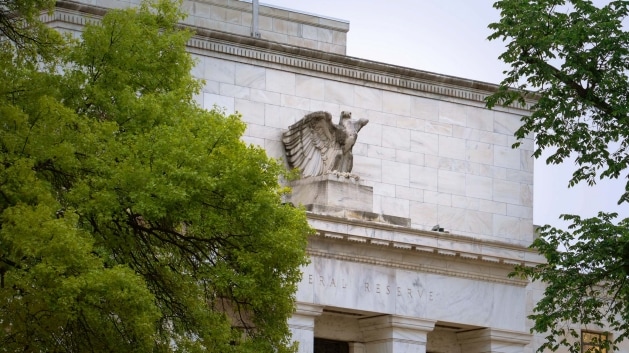
May 2025 Fed Meeting: Rates hold firm again as FOMC takes ‘wait and see’ approach

Editorial staff, J.P. Morgan Wealth Management
- The Federal Reserve (Fed) held interest rates steady at the 4.25% to 4.5% range during its May meeting, as expected.
- Currently, the Fed sees the economy growing at a modest pace, with inflation slightly above their 2% target.
- However, the Fed acknowledged that since their last meeting in March, the risks of higher inflation and higher unemployment have increased, in part due to trade policy.
- In his press conference, Fed Chair Jerome Powell noted that their existing policy is “in a good place” and can allow them to respond swiftly as economic conditions evolve.
- Our strategists still anticipate the Fed will lower interest rates in the second half of the year, but uncertainty remains elevated.

The Federal Reserve (Fed) kept its benchmark interest rate unchanged in May, holding the line at 4.25% to 4.5%, much like it did at the March meeting. But beneath the headline are countercurrents keeping the Federal Open Market Committee (FOMC) alert to changes in the macro environment.
What did we learn from the FOMC’s May announcement?
Although the May meeting did not provide fresh economic forecasts, which are scheduled for June, J.P. Morgan Wealth Management Global Investment Strategist Vinny Amaru believes “the Fed's recent statement emphasized that the economy continues to expand at a moderate rate despite some recent trade data anomalies, mostly due to the likely front-loading of imports ahead of potential tariffs.”
In general, the Fed noted that labor market conditions remain strong and that inflation is just slightly above the 2% target – marking significant progress over the past few years.
Nonetheless, the Fed is acutely aware that uncertainty surrounding the U.S. economic outlook has grown since its previous meeting in March. It acknowledged the increased risks of both rising unemployment and inflation, presenting a challenging scenario for the Fed to navigate. An uptick in unemployment might require rate reductions, whereas elevated inflation could call for the opposite approach. This delicate balancing act may become a focal point for Fed policy decisions in the second half of the year.
Work with an advisor
Our advisors can provide ongoing financial advice on how your portfolio can adapt to the changes in the market, your life and your goals.
Markets largely unaffected by ‘wait-and-see’ stance
Markets did not expect a rate cut in May and they didn’t get one. Major indexes in the U.S. were up under 1% after the announcement, signaling that markets were mostly aligned with the outcome of the May meeting. The same muted outcome was present in fixed income markets, with U.S. 2-year and 10-year Treasury yields remaining mostly unchanged following the release of the FOMC statement and press conference.
Powell reiterated that the recent economic data on the labor market and consumer spending continue to be resilient, while general sentiment data has weakened. This divergence between what consumers are doing and what they are saying is helping to keep the Fed on the sidelines for now – the central bank will need to see weakness in what consumers are doing before it makes any policy rate adjustments. Powell mentioned numerous times in his press conference that the Fed’s existing policy stance remains “in a good place” and leaves the central bank well positioned to respond to how economic conditions evolve in the coming months.
What does the Fed’s announcement mean for investors?
The Fed’s message in regards to future rate cuts was it’s too early to tell, but our strategists still expect the Fed to cut interest rates in the second half of the year. Investors can stay ready by:
- Making sure you know your risk tolerance: Until tariff policy becomes more clear, market volatility will remain elevated. Make sure your investment portfolio is aligned with your longer-term goals and risk tolerance.
- Watching economic data closely: As Powell said, there is more risk of potential higher inflation and unemployment than there was at the start of the year. How the labor market and inflation respond to existing tariff policy will be key, with the release of the next Consumer Price Index (CPI) report on May 13 expected to play a role as well.
- Staying diversified: You’ve heard it a hundred times and it’s still true. As Amaru states, “For investors, the heightened volatility experienced since the start of the year continues to reinforce the potential benefits of geographic and asset class diversification – a strategy that will continue to be part of our outlook as we move into the latter half of the year.”
As always, consult a J.P. Morgan advisor to learn how these developments could affect your investing portfolio.
Invest your way
Not working with us yet? Find a J.P. Morgan Advisor or explore ways to invest online.