Why setting up recurring transfers could support your investing strategy

Editorial staff, J.P. Morgan Wealth Management
- Recurring transfers can help you make steady progress toward long-term goals, like building up an investment portfolio.
- By automating contributions, you may be able to take some emotion out of investing.
- Regular contributions can also help you take advantage of dollar-cost averaging.

Be kind to your future financial self. How? One way is to invest at a regular cadence.
Recurring transfers are automatic transfers set up between your bank accounts and your investment accounts. These transfers can be simple to set up online, and they can help you stay on track with your financial strategy by removing the need to move money manually between accounts.
Think about it like a garden: Regular planting and watering can help support steady growth over time. You can apply the same concept to investing.
Common types of recurring transfer strategies investors use
There are several ways investors use recurring contributions as part of an investing strategy. Consider the following options:
- Periodic investment plans (PIPs): A fixed amount of money is invested at regular intervals (like monthly or quarterly) into mutual funds, stocks or other investment vehicles. This may involve setting up automatic transfers from a bank account.
- Dividend reinvestment plans (DRIPs): Instead of receiving dividends as a payout, the investment account holder’s dividend earnings are reinvested into additional shares of stock, an exchange-traded fund (ETF) or a mutual fund. This is a form of automatic reinvestment because dividends are used to buy additional shares without requiring manual action.
- Payroll deductions: Offered by some employers, payroll deductions allow individuals to direct a portion of each paycheck – sometimes pre-tax – into an employer-sponsored retirement account.
Get up to $1,000
When you open a J.P. Morgan Self-Directed Investing account, you get a trading experience that puts you in control and up to $1,000 in cash bonus.
Comparing types of recurring contribution strategies
Payroll deductions | Periodic investment plans (PIPs) | Dividend reinvestment plans (DRIPs) |
|---|---|---|
Description | ||
Deductions from paychecks – sometimes pre-tax – are used to build an investment account over time | Investments are made at regular intervals | Dividends are reinvested into more shares of stock, a mutual fund or an ETF |
Common uses | ||
To invest in an employer-sponsored retirement plan | To invest in mutual funds, stocks and other vehicles | To invest dividend income in more shares of that dividend-paying investment |
Potential benefits | ||
Consistent contributions; dollar-cost averaging | Consistent contributions; dollar-cost averaging | Automatic reinvestment; potential compounding via reinvested dividends |
Potential benefits of using recurring transfers to invest
Setting up recurring transfers may provide several advantages to investors. Let’s walk through some of them.
Automation
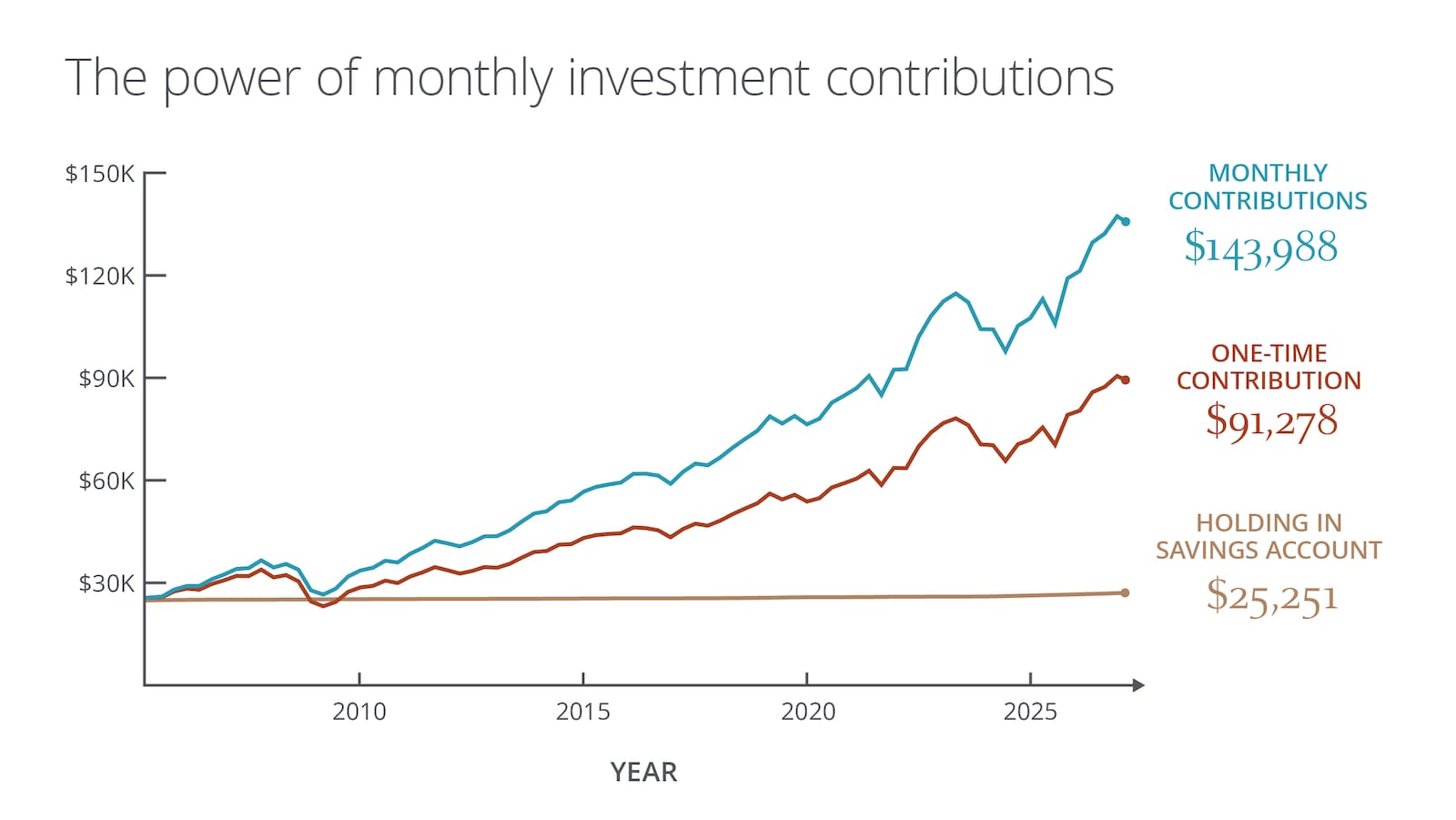
Setting up recurring transfers can help you contribute regularly to your investment portfolio. Over time, consistent contributions may help support compounding if your investments earn returns. This approach can also simplify the process and reduce manual effort. By automating, you can shift your focus to other aspects of your strategy while knowing your contributions are steadily building.
Taking the emotion out of investing
Recurring transfers may help reduce the guesswork and emotion around when to invest. You’ll still need to choose the investments your contributions will go into.
Dollar-cost averaging
Regular investing can support a dollar-cost averaging approach: Over time, you may buy fewer shares when prices are higher and more when prices are lower.
Time savings
Managing how much to invest – alongside bills and discretionary spending – takes time. Recurring transfers can reduce the need to revisit the mechanics each time you want to invest.
Help with large investments
Recurring transfers may also help when you want to add a larger amount to your portfolio, like after you receive a bonus or a large gift. If you know you want to invest a sizable amount but aren’t sure when to do so, you might spread contributions out (for example, equal amounts over three months). This can reduce the risk of investing a large sum at an unfavorable time. However, there are tradeoffs: depending on market performance, investing earlier may produce different results than spreading it out.
Potential drawbacks of using recurring transfers to invest
Recurring transfers can also have their drawbacks, and investors need to be aware of them. Here are a few to consider:
Lack of flexibility
If you set up recurring transfers, check in periodically and adjust as needed. The last thing you want is an unexpected increase in expenses (or decrease in income) while your transfer amount stays on autopilot.
Over-automation risks
Automation can be helpful, but it can also lead to complacency. Review your transfers periodically to make sure they align with your goals and risk tolerance.
Fees and costs
Some financial institutions may charge fees for certain transfers or account features, so be sure to know what those fees are and factor such costs into your investment strategy.
How to set up recurring transfers into an investment account
Start by choosing the accounts involved and the frequency (weekly, biweekly, monthly or something else). Then assess your budget to decide how much you can transfer each time. Consider starting small and working your way up. Many banks and brokerages let you set this up online.
Common mistakes to avoid if you set up recurring transfers
No investment strategy is foolproof, no matter how simple it may seem. After you set up recurring transfers, review them periodically so they still fit your budget and goals.
Stay vigilant when your financial situation changes and adjust your transfers accordingly.
Lastly, be aware of any fees associated with recurring transfers because they can add up over time.
The bottom line
Setting up recurring transfers may be straightforward, but the potential long-term impact on your portfolio could be significant. By automating these transfers, you may reduce guesswork in investing and support financial discipline over time.
Once you’re comfortable with the basics of recurring transfers, you can consider further integrating, targeting and adjusting them to suit your needs, too.
For example, combining your transfers with other financial tools like budgeting apps can help you better visualize where your money is going from a big-picture view. Or maybe you want to focus your transfers on a specific aim, such as retirement or education, so you can reach your goals more efficiently. Tweaking the transfer amounts – and their frequency – as your financial situation evolves is yet another easy way to help maintain flexibility.
You also might want to consider consulting with a financial advisor to ensure your strategy aligns with your overall financial goals.
Invest your way
Not working with us yet? Find a J.P. Morgan Advisor or explore ways to invest online.