How to invest in foreign stocks: Options, risks and costs

Editorial staff, J.P. Morgan Wealth Management
- Investing in foreign stocks can help diversify and potentially grow your portfolio.
- U.S. investors can invest abroad through American depositary receipts (ADRs), international exchange-traded funds (ETFs), international mutual funds, over-the-counter (OTC) markets, global depositary receipts (GDRs) or direct foreign investments. They can also consider investing in U.S.-based multinational corporations with foreign exposure.
- It’s important to be aware of the potential downsides of investing abroad, such as higher costs, increased risk and limited liquidity.

Investing in foreign stocks can help diversify your portfolio by spreading investment risk across global markets. It can also help expand your potential growth opportunities – especially in faster-growing emerging markets.
But how do you get started, and what risks should you consider? Here are the basics you need to know as you explore if this strategy is right for you.
How can you trade international stocks from the U.S.?
As a U.S. investor, you can access global markets in several ways. Here are some of the options to consider.
American depositary receipts (ADRs)
One common way to invest internationally is to buy ADRs through U.S. brokers. A depositary bank typically buys shares of foreign companies on foreign exchanges and issues ADRs that represent those shares. One ADR can represent one or more shares of foreign stock or a fraction of a share. ADRs are then listed on U.S. exchanges and OTC markets. Once you’ve purchased an ADR, you may be able to convert it into the foreign stock it represents, but it may be more cost-effective just to own the ADR.
Direct investments/international stocks
While not as popular as trading ADRs, you can trade foreign stocks directly. Foreign companies may list their stocks on exchanges in the U.S. and their home countries via ADRs or dual listings. You can invest in them by opening an international trading (global) account with a U.S. broker or finding a local broker in the target country. However, it’s important to note that not all U.S. brokers offer global accounts, so you should verify this capability with your broker.
Also, the latter option may come with more risk, as you’ll have to vet foreign brokers for legitimacy. You could also encounter language barriers, limited information on investments, regulatory differences and unanticipated costs, including tax implications.
International ETFs and mutual funds
Another way to gain international exposure is to invest in international-focused mutual funds or ETFs. These funds may provide broader diversification than most investors can achieve on their own.
When it comes to international ETFs and mutual funds, these are just some of the options you can choose from:
- Global funds: Invest in both U.S. and non-U.S. companies.
- International funds: Invest primarily (or entirely) in non-U.S. companies.
- Regional or country-focused funds: Focus on a specific region or country.
- International index funds: Aim to track the returns of a specific non-U.S. index.
OTC foreign stocks
OTC markets refer to decentralized trading that occurs between two parties or through networks of broker-dealers, rather than on centralized exchanges like the New York Stock Exchange. For example, a popular OTC network in the U.S. is the OTC Markets Group, which connects broker-dealers and provides data and quote services for thousands of securities.
OTC markets tend to offer a broad range of securities but may involve higher risks due to less regulatory oversight – and less required reporting by companies – than traditional exchanges. This may lead to investors having less information to use to make informed investment decisions.
Stocks that trade OTC include shares of smaller companies that do not meet the requirements to be listed on a national exchange, including penny stocks. These stocks may involve increased risk. Large-cap ADRs and foreign ordinary stock shares that trade in the U.S. may also trade OTC.
Global depositary receipts (GDRs)
GDRs are a type of depositary receipt in which a bank issues receipts that represent shares of a foreign company in an international market. The main difference between GDRs and ADRs lies in their trading location. GDRs typically trade outside the U.S., while ADRs are designed to trade in the U.S. market.
Multinational corporations
If you want to dip your toes in international investing without directly buying foreign stocks or funds, you may want to consider investing in U.S.-based multinational corporations. When companies earn a significant portion of their revenue abroad, they can help diversify your investment risk beyond the U.S.
While investing in multinational corporations can provide indirect exposure to international markets, it’s important to understand that it won’t equate to direct investment in foreign stocks, and because of that, it may not offer the same level of diversification.
Comparison of international investment options
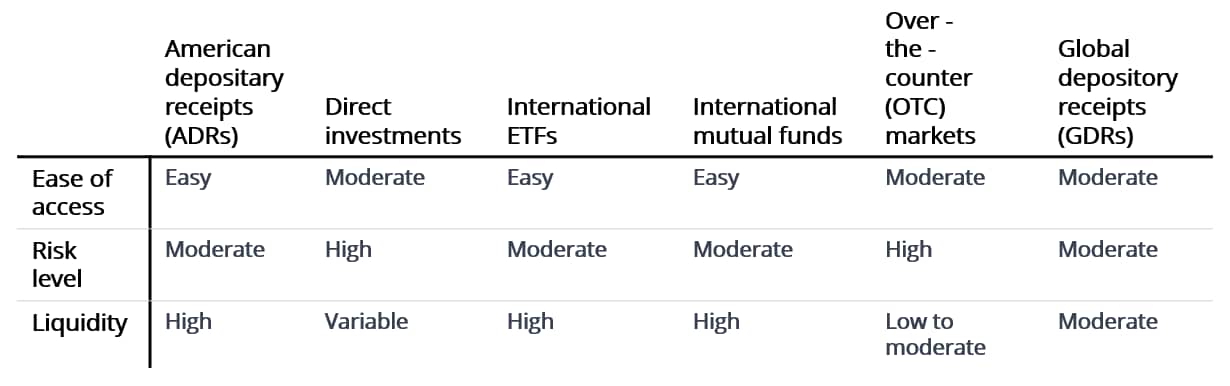
These are general tendencies; actual risk/liquidity depend on the security and market.
Get up to $1,000
When you open a J.P. Morgan Self-Directed Investing account, you get a trading experience that puts you in control and up to $1,000 in cash bonus.
Considerations to make before investing in international stocks
There are several factors to consider as you decide whether international stocks are right for you and which options to pursue.
- Costs: Investing in international stocks can come with unexpected costs. You may encounter unexpected taxes, currency conversion costs, higher transaction fees and higher broker commissions.
- Investment information: If a foreign company is not subject to the reporting rules of the Securities and Exchange Commission (SEC), it can be harder to assess an investment opportunity. Reporting standards vary by country in terms of depth, frequency, language and more.
- Risk: International investments can be subject to dramatic changes in market value. The SEC recommends being prepared to ride out sharp, long-lasting downturns. It can also be more difficult to fully analyze the factors that influence foreign investments, including social, political and economic factors, which can make them riskier.
- Currency exchange rates: Investors should be aware of currency exchange rates, which can significantly impact returns.
- Taxes: International investments may be subject to foreign taxes, such as the withholding of taxes on dividends. It’s important to understand the tax treaties between the U.S. and the country of investment because they can affect your tax burden. Foreign investments may also be subject to U.S. taxes.
- Accessibility/convenience: Some international investment vehicles are easier to invest in than others. For example, ADRs and international ETFs can be traded on U.S. stock exchanges, making them available for U.S. investors with standard brokerage accounts. In contrast, GDRs and direct investments in foreign stocks are typically traded on foreign exchanges, which involves venturing into unknown territory for many investors.
- Legal remedies: If issues arise with a foreign investment, your ability to take legal action may be limited. For example, if a foreign company is not registered in the U.S., you may not be able to collect on a U.S. judgment against it.
- Liquidity: Foreign markets may offer lower liquidity levels than U.S. markets due to factors such as lower trading volumes, fewer trading hours and purchase restrictions.
Investing internationally comes with various risks but also holds the potential for growth and diversification. To curb your risks, be sure to perform your due diligence on any foreign market and investment you’re considering. Gather as much information as you can, not only on the specific investment but on the market you’re entering and the investment type you’re considering.
Pros and cons of investing in international stocks
There are many pros and cons to consider when it comes to investing in international stocks. Here are some of them:
Pros
- Portfolio diversification: Investing in international markets can potentially reduce your overall portfolio risk by spreading exposure across different economies.
- Currency diversification: Holding assets in other currencies can help offset drops in the value of the U.S. dollar.
- Growth opportunities: International markets, especially emerging markets, may offer high growth opportunities, though they may also come with increased risks.
- Versatility: There are many ways to invest in foreign stocks and funds, which can suit the preferences of investors with varying risk tolerance levels and preferences.
Cons
- Unanticipated costs: International investments can come with unexpected costs due to taxes, currency conversions and fees.
- Information shortages: In some cases, it may be difficult to find reliable, comprehensive information on some foreign investments.
- Harder to navigate: Investing in foreign stock markets can be more complex than investing domestically due to factors like currency conversions, language barriers, differing accounting standards and varying regulatory frameworks.
- Higher risk: Investing internationally can come with more risk due to factors such as fewer investor protections, economic or political instability in foreign countries and liquidity limitations.
The bottom line
Investing in international stocks can help diversify your portfolio and open the door to unique global growth opportunities. Whether you prefer to start cautiously by investing in U.S.-based multinational corporations, invest in ADRs or venture into direct international investments, you have no shortage of options.
All that said, it’s important to be aware of the risks that may come with this investment choice, and an in-depth analysis may be helpful. For example, you can consult an international investment advisor, perform due diligence on potential investments and consider how much of your portfolio makes sense to allocate to international investments.
Frequently asked questions about investing in foreign stocks
You don’t need a foreign investment account to buy international stocks. There are multiple ways to invest internationally, and several of them allow you to go through a U.S. broker or brokerage account.
International stock markets refer to stock exchanges worldwide, such as the London Stock Exchange, the Tokyo Stock Exchange and the Frankfurt Stock Exchange. Most countries have at least one stock exchange.
Yes, it’s possible to invest in international currencies through forex (foreign exchange) transactions, as well as through other financial instruments like currency-focused ETFs and foreign bonds.
Invest your way
Not working with us yet? Find a J.P. Morgan Advisor or explore ways to invest online.