How advances in artificial intelligence may change health care

Editorial staff, J.P. Morgan Wealth Management
- The breakneck speed at which global health services has developed in the past few years requires the health care industry to deliver fast, accurate results more than ever – enter artificial intelligence (AI).
- As the global population continues to age and health care costs creep up, managing health care costs will be front and center for many economic and political decisions in the coming years.
- AI can accelerate the drug research and development (R&D) process and improve patient outcomes at a fraction of the current price, hopefully making health care accessible to many more people.
- While AI has the potential to transform many areas of health care, drug discovery and diagnostics are two markets that may see the largest impacts in the foreseeable future.

The past few years have seen an explosion in the availability of digital health services, largely spurred by the COVID-19 pandemic (and several other key factors). The necessary, rapid deployment of these services has led to continued advancements in health care technology since their mass introduction in 2020.
In 2024–25, generative artificial intelligence (AI) expanded the possibilities for further advancements in the field. As the global population continues to age and health care costs creep up, managing these costs will be front and center for many economic and political decisions in the coming years. Such decisions may be more keenly felt in countries like the United States, which has much higher health care costs relative to many other countries.
Following this, improving patient outcomes while decreasing the cost of health care services has never been more important. When we consider the predicted trajectory of AI advancements in the coming years, patients, doctors and researchers will likely benefit in ways we cannot currently fathom. By improving these patient outcomes at a fraction of the cost, AI can hopefully make health care more accessible.
Given AI’s potential to both streamline medical procedures and subsequently lower health care costs, we see a possible window of investment opportunity here. And while AI certainly has the potential to transform many areas of health care, drug discovery and diagnostics are two markets that may see the largest impacts in the foreseeable future. Let’s dive in.
Innovations in medical research
One health care sub-field that is already reaping the benefits of AI is drug research and development (R&D). Not only did AI play a crucial role in creating the COVID-19 vaccines, but it has also massively accelerated the vaccine development process, shortening it to a mind-boggling time frame of a year or so.
AI solutions might also benefit medical research and testing behind new drugs. Like researching new drugs, the developmental process behind perfecting a new drug typically takes years or even decades. However, AI may also be able to speed this up, too.
Fortunately, though, this potential is already being realized in some key ways. One of the strongest cases for AI solutions in the area of drug discovery came a few years ago from DeepMind, an AI research lab from Google.
DeepMind used AI to predict the three-dimensional structures of essentially every know protein in biology (i.e., approximately 200 million proteins) including all proteins in the human genome. Think of 3D protein structures as critical building blocks that aid in many functions of the body, like the immune system. DeepMind’s database of all the protein structures has already helped scientific researchers make new discoveries. For instance, scientists used this database to help them develop a new vaccine for malaria, which kills hundreds of thousands globally each year.
AI can even enhance development at the more advanced stages involving testing and clinical trials. In other words, AI can help make certain parts of clinical trials more efficient and safe for participating patients. Combined with machine learning (ML) algorithms, these AI systems can be trained on previous data from similar trials and drugs. This would in turn allow AI models to help identify the best patient candidates to include in a trial, calculate the best dosage levels and timing and – perhaps most importantly – flag any potential side effects of the drug on participating patients.
As you can see, AI can expedite this developmental process, play a role in lowering the costs and risks of clinical trials and potentially increase the success rate in new drug trials. But how else can AI improve health care?
Get up to $1,000
When you open a J.P. Morgan Self-Directed Investing account, you get a trading experience that puts you in control and up to $1,000 in cash bonus.
Improvements in medical imaging and other diagnostic tools
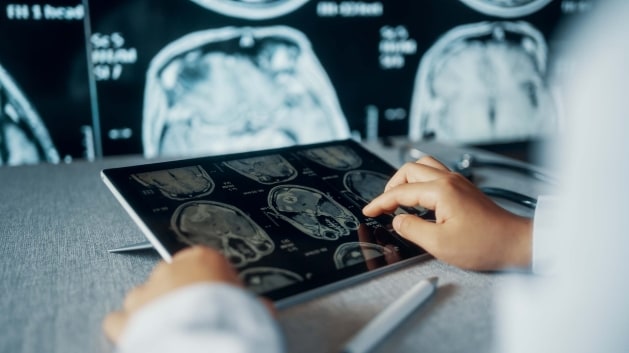
The diagnostics market is also reaping the benefits of this technology. Medical diagnostics has recently received increased attention when it comes to AI’s potential implications in radiology. To illustrate this, AI has streamlined certain procedures like X-rays and CT imaging, making them more efficient for both health care providers and patients.
Over the past several years, AI solutions have helped radiologists read and interpret medical scans to boost efficiency and provide faster results. But these solutions can be applied even further – for instance, AI can be used in tandem with other medical technology to mitigate radiation risks for each individual scan while still maintaining accuracy.
Indeed, the increased focus on AI across medical imaging is already apparent. For example, the number of AI-powered medical devices that have met the U.S. Food and Drug Administration’s (FDA) applicable premarket requirements has surged in recent years. To give you an idea of how quickly this list is growing, hundreds of AI-enabled medical devices have made the FDA list of approval in the past few years alone, up from around 10 or so not even a decade ago.
How do humans fit in?
The sheer volume of these AI-enhanced health care solutions shows the impact that AI has already had on certain sub-fields within the industry, particularly in radiology. As of mid-2024, 76% of all AI-enabled medical devices that met the FDA’s applicable premarket requirements were in radiology.
But don’t expect AI to replace human doctors or other medical professionals any time soon. Even though just a few years ago some were forecasting massive job losses in radiology thanks to AI, this has clearly not happened. In fact, some studies show that radiologists can outperform AI systems when making a diagnosis based on medical images. This underscores the idea that radiologists can use AI as a collaborative tool that helps them perform their job more efficiently, rather than have it put them out of work.
And since developing these AI systems requires training them on massive amounts of data to deliver the results we want, in many cases (particularly for rare diseases), this volume simply does not exist yet. Again, this highlights the need for a human touch to interpret more sophisticated CT scans.
The bottom line
Selectivity is key when researching possible investment opportunities in these particular sub-fields of health care. Large, profitable pharmaceutical companies with strong cash flows and significant resources to devote toward R&D may prove worthy investment candidates. This is because larger pharmaceutical companies can afford to be more defensive and tend to have positive earnings growth – even in stretches of market volatility.
But as is with all investments, there are inevitably a few key risks you should keep in mind. For example, be mindful of heightened regulatory environments, which may slow new drug and treatment innovation. Another variable to watch out for is price controls on new drugs, which could translate to widely varying prices across different countries. Additionally, data privacy and cybersecurity will also become critical for any big data or AI applications in health care, as protecting patients’ privacy remains a primary concern for health care providers.
If you’re curious how investing in this area may impact your current investment strategy, consult a financial advisor.
Invest your way
Not working with us yet? Find a J.P. Morgan Advisor or explore ways to invest online.